
Water gets in at a seam or a rooftop fitting, runs along the metal or the roof decking, and drops through the ceiling wherever it finds a gap. So the stain in your living room may be several feet from where the roof is actually failing. Finding the entry point is most of the job.
The usual entry points
Many manufactured homes have a low-slope or flat metal roof; some newer ones have shingles over a peaked roof. Different surfaces, but leaks almost always start at a seam, a penetration, or worn-out coating.
- Cracked or peeling sealant around vents, plumbing jacks, the AC curb, and skylights.
- Ponding water that stands on a flat roof after rain and works through the seams.
- Chalky, alligatored coating that no longer sheds water.
- Rusted or separated seams on older metal roofs.
- Lifted, torn, or missing shingles and failed flashing on peaked roofs.
Tracing it to the source
Mark the stain inside, then get on the roof and work uphill from that point. Check the high side of every penetration first, because sealant tends to crack on the sun-facing side before anywhere else. On a metal roof, run your eye and a hand along each seam. On a peaked roof, look for damaged shingles and lifted flashing. A careful hose test, wetting one section at a time while someone watches inside, will pin down a stubborn leak.
Is the leak still active?
Before you open anything, figure out whether you are chasing a live leak or an old scar. A soft, damp stain with feathered edges that keeps growing is active. A hard, dry, sharply outlined brown ring that never changes after rain is probably years old and already fixed. A cheap moisture meter settles the argument. Tearing into a ceiling to chase a leak that stopped long ago is a common and avoidable mistake.
Patch or re-coat
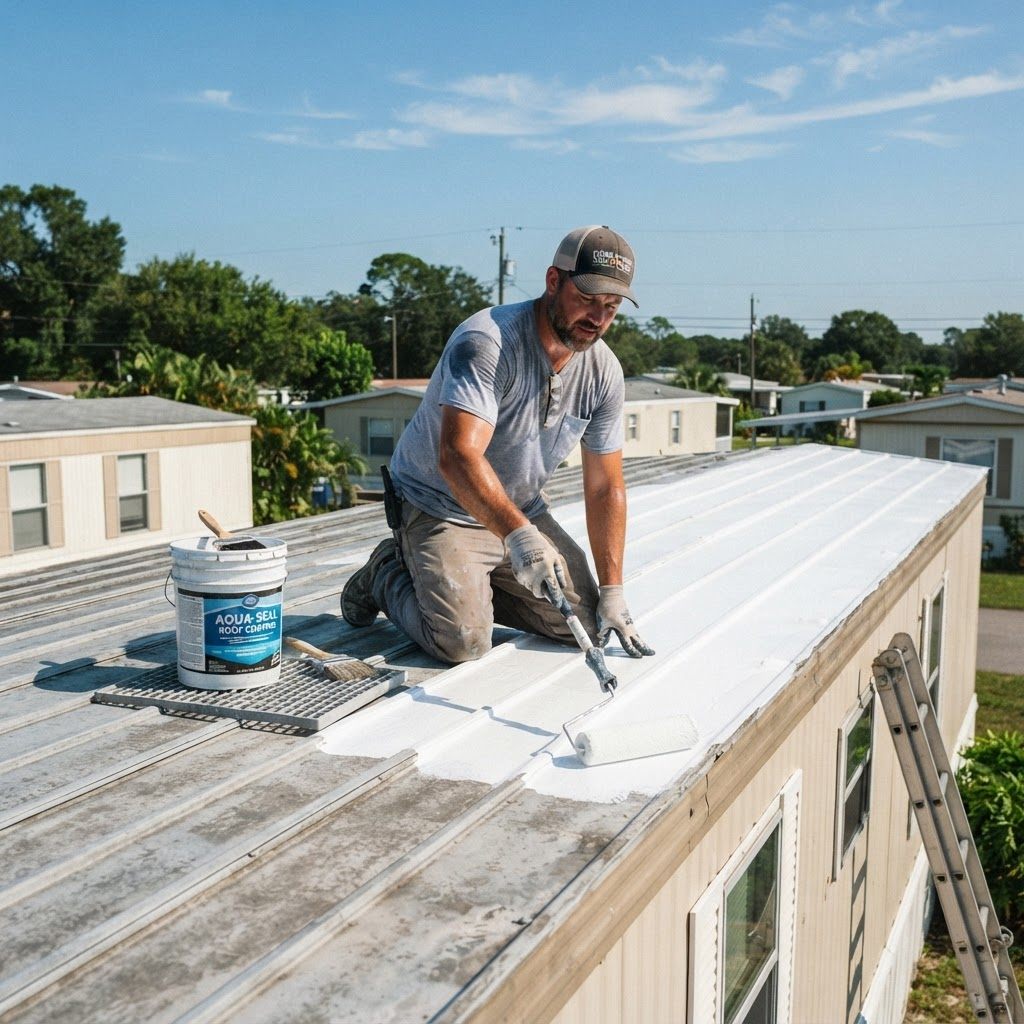
A spot repair makes sense for one obvious failure, like a single cracked seam on an otherwise sound roof. But when the coating is chalky and cracking across the whole surface, patching one spot just creates the next weak edge a foot away. The fix that actually ends the cycle is to repair the failures, prep the surface, and apply a full elastomeric coating so the entire roof becomes one watertight membrane again.
When to hand it off
Walking a mobile home roof is genuinely risky. The panels are thin, slick, and easy to dent, and a dent becomes tomorrow's leak. If water is actively coming in, the ceiling is sagging, or you are looking at ponding and failed coating across the whole roof, this is work for someone who can do it safely and re-coat it properly. Around Sacramento, roofs bake all summer and coatings go brittle, so the first heavy fall rain often finds several tired seams at once.
Key Takeaway
Trace the leak uphill from the stain, confirm it is actually active, then seal the failed seams and fittings. If the coating is shot across the roof, re-coat the whole surface rather than caulking drips one at a time, which is how a small leak becomes a rotted ceiling.
Need roof repair in Greater Sacramento?
We specialize in mobile and manufactured homes and diagnose the real cause before any work begins. Get a free, no-pressure estimate.